Gaboon viper
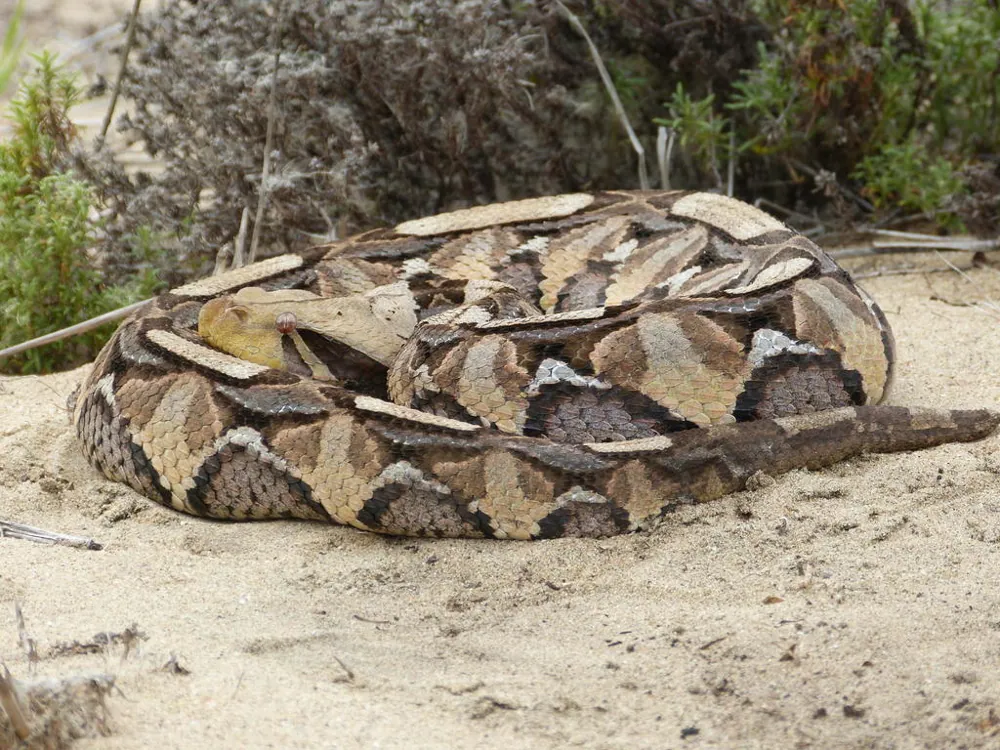
The Gaboon viper is a large, heavy snake with a striking pattern of pale and dark markings. It lives in the rainforests and savannas of sub-Saharan Africa. It is one of the most venomous snakes in the world, so knowing what it looks like matters.1
🔍 How to recognise it
- A large, heavy, stout body, with a large triangular head and a neck much narrower than the head1
- A series of pale, rectangular blotches down the centre of the back, with dark hourglass markings edged in yellow1
- A white or cream head with a fine dark central line and a dark blue-black triangle behind and below each eye1
- Small raised 'horns' between the nostrils, which are tiny in this species1
- Its camouflage works well among dead leaves under trees, so it can be hard to see1
Often confused with: The Congolese giant toad (Sclerophrys channingi) may be a mimic of this snake. Its head appears to resemble the viper's head, while its body is darker.1
Venom power
Venom comes out through its fangs or teeth when it bites.
What does its venom do?
The venom is cytotoxic, which means it damages cells, and cardiotoxic, which means it harms the heart. The text does not give the speed or the full list of symptoms. Each bite can deliver a large amount of venom, because the snake does not release its grip after biting.1
How dangerous is it to people?
Danger to people: Very dangerousIt can kill a person who gets no treatment.Bites are extremely rare, because the snake is seldom aggressive and lives mostly in rainforest areas. Most bites happen when people accidentally step on it. The text says that even an average bite from an average-sized snake is potentially fatal.1
💉 Good news: doctors have a medicine (antivenom) or a treatment for this.1
What does it do when it is scared?
When threatened it hisses loudly in a deep, steady rhythm and flattens its head slightly with each breath. It is unlikely to strike unless it is severely provoked.1
🚑 If it bites or stings
- The text says any bite should be treated as a serious medical emergency. Antivenom should be given as soon as possible to save the limb or the person's life. The text does not describe other first aid steps.1
- Keep the person still and calm, keep the bitten limb at heart level, remove rings and tight things, and get to a hospital fast.
Always call your emergency number first (112, 000, 911). This is general first aid guidance, not medical advice. First aid basics
⛑️ Stay safe
- Never touch, catch or tease a wild animal, even a small one, and even if it looks asleep or dead.
- Give it space. If you meet one, stay calm, step back slowly and let it go its own way.
- If one bites or stings you: stay calm, keep still, call your emergency number (112, 000, 911) or get to a hospital fast. Remember what it looked like, a photo helps.
It is not out to get you. It uses its venom to catch food or to protect itself, and it would much rather hide. More about staying safe
Where in the world?
How big is it?
How long is it?
How heavy is it?
 as long as 4 house cats nose to tail🍌as long as 10 bananas end to end🏃could cover 100 metres in 90 seconds (the fastest human needs 9.6)
How big is Gaboon viper compared to YOU?
Just maths in your browser. Nothing is saved or sent anywhere.
How fast is it?


Facts
A 1.8 m specimen caught in 1973 weighed 11.3 kg with an empty stomach. It is the heaviest venomous snake in Africa.1
Its eyes can move in unusual ways. If its head is turned 360°, one eye tilts up and the other tilts down.1
Unlike many African vipers, such as the puff adder, it does not release its grip after biting.1
Males fight by intertwining their necks and pushing. The winner pushes the other's head to the ground and raises his own head by 20–30 cm.1
Although it is one of the fastest-striking snakes in the world, it usually tolerates handling and rarely bites or hisses.1
Myth buster
Myth: Because it is calm and tolerant, it is safe to handle.
Truth: The text says some writers have described it as so docile it can be handled as freely as a harmless snake. The text states plainly that this is absolutely not recommended, because it is one of the fastest-striking snakes and bites by bad-tempered individuals do occur.1
Where the facts come from
- Gaboon viper (Wikipedia (CC BY-SA 4.0))
- Bitis gabonica (iNaturalist): names and classification.
- Venom Wiki: the danger level, the typical size and the speed guess are our own. See how we work them out: How we rate danger.
Every fact on this page has a number that points to its source. If we got something wrong, sorry, we are animal fans, not a science journal. Tell us at [email protected] and we will fix it.
 The spider is hungry! Venom Wiki is a dad's project for his animal-loving kids, free with no ads and no trackers. Grown-ups can drop a snack in the basket to help keep it online.Feed the spider
 Puff adder
 Northeast African carpet viper
 West African carpet viper
 Rhinoceros viper
 West African Gaboon viper
 Horned adder
 Black mamba
 Deathstalker
 Egyptian cobra
 Boomslang
 Fat-tailed scorpion
 Western honey bee