
Portuguese man o' war
The Portuguese man o' war looks like a jellyfish, but it is actually a colony of many tiny linked animals that work together as one. It drifts on the surface of the Atlantic, Indian and Pacific oceans, and its long tentacles sting prey. Its sting is painful to people, and in some cases it can kill them.1
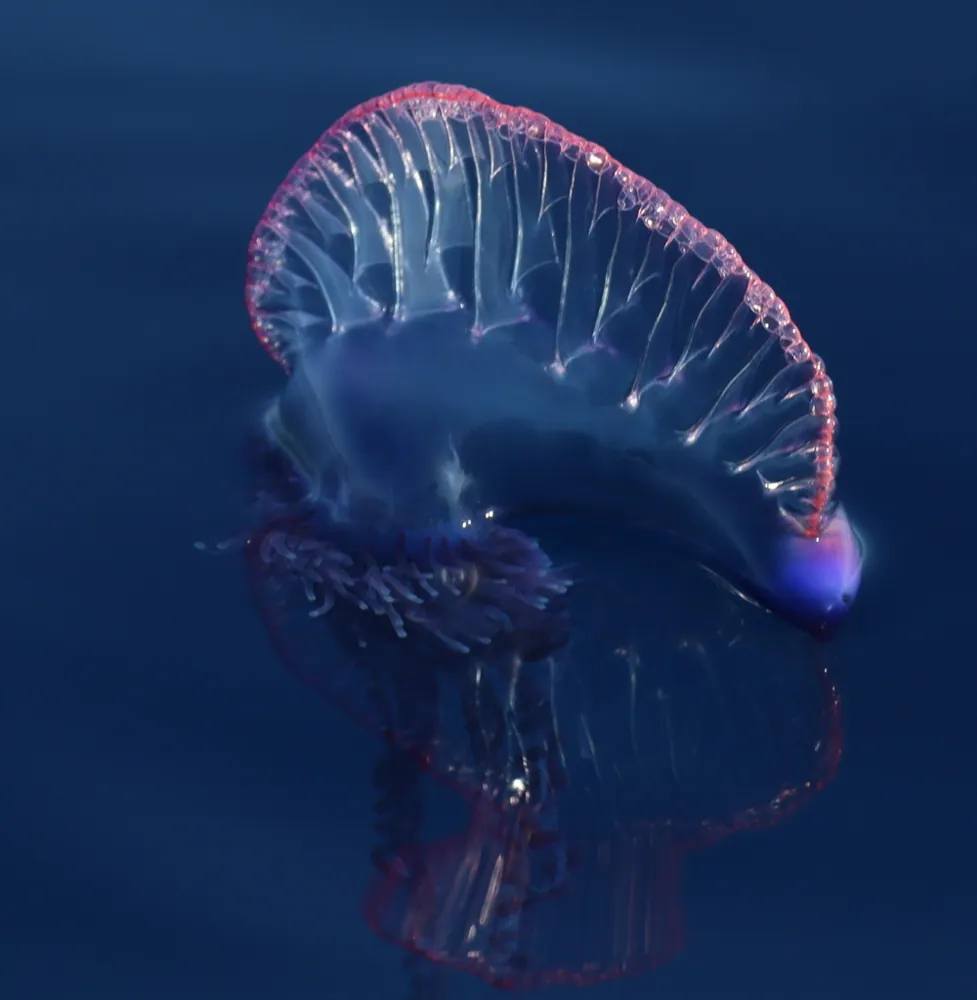
🔍 How to recognise it
- A gas-filled bladder called the pneumatophore floats on the surface and acts as a sail.1
- Long tentacles, which can reach over 30 m, hang below the surface.1
- The float can be up to 30 cm long, 13 cm wide and 15 cm tall.1
- Groups can be large, sometimes over 1,000 animals.1
- The sail may be left- or right-handed, depending on the way the wind catches it.1
Often confused with: It superficially resembles a jellyfish, but it is a siphonophore, a colonial animal made of many smaller units called zooids. The text does not give further details on how to tell it apart from other animals.1
Venom power
Thousands of tiny stinging cells fire when something touches them.
What does its venom do?
Its tentacles carry nematocysts, tiny coiled, thread-like stingers that inject venom on contact. The venom can paralyse small fish and other prey. The text says the sting is powerful enough to kill fish, crustaceans and, in some cases, humans.1
How dangerous is it to people?
Danger to people: SeriousA bite or sting needs a doctor. Deaths are very rare.The text says its stings are painful and that it is well known to beachgoers. In some cases the sting can kill humans. Large groups can also reduce fish populations and damage fishing supplies.1
What does it do when it is scared?
When attacked at the surface, it can deflate its pneumatophore and temporarily submerge.1
🚑 If it bites or stings
- Get out of the water and pick off any tentacles (with gloves or a cloth).
- For tropical box jellyfish: pour vinegar on the stings for at least 30 seconds, call for help and be ready to do CPR. For bluebottles and most others: rinse with seawater, then hot water for the pain.
Always call your emergency number first (112, 000, 911). This is general first aid guidance, not medical advice. First aid basics
⛑️ Stay safe
- Never touch, catch or tease a wild animal, even a small one, and even if it looks asleep or dead.
- Give it space. If you meet one, stay calm, step back slowly and let it go its own way.
- If one bites or stings you: stay calm, keep still, call your emergency number (112, 000, 911) or get to a hospital fast. Remember what it looked like, a photo helps.
It is not out to get you. It uses its venom to catch food or to protect itself, and it would much rather hide. More about staying safe
Where in the world?
How big is it?
How long is it?
How big is Portuguese man o' war compared to YOU?
Just maths in your browser. Nothing is saved or sent anywhere.
How fast is it?

Facts
It is not a single animal. It is a colony of zooids, all genetically identical, that work together like organs in one body.1
Its float can produce carbon monoxide, which makes up as much as 13% of the gas inside it.1
The loggerhead sea turtle eats it regularly, because its thick skin protects it from the stings.1
The blanket octopus is immune to its venom and uses broken tentacles as weapons.1
The man-of-war fish can live among its tentacles and feeds on them, while avoiding being stung.1
Its name, Physalia, comes from the Greek word for 'bubble' or 'bladder'.1
Myth buster
Myth: It is a jellyfish.
Truth: It only looks like a jellyfish. It is a siphonophore, a colony of many linked zooids.1
For venom experts
- Scientific name
- Physalia physalis
- Group
- Jellyfish & sea stingers
- Also called
- Man-of-war, Bluebottle, Caravela Portuguesa1
- Family
- Physaliidae2
- Order
- Siphonophorae
- Continents
- The oceans
- Babies
- Each colony is either male or female, and eggs or sperm are released into the water, where a fertilised egg develops into a planula (a free-swimming larva) that grows into a new colony. The number of young is not given in the text.1
- Danger to people
- 3 / 5: Serious3
Where the facts come from
- Portuguese man o' war (Wikipedia (CC BY-SA 4.0))
- Physalia physalis (iNaturalist): names and classification.
- Venom Wiki: the danger level, the typical size and the speed guess are our own. See how we work them out: How we rate danger.
Every fact on this page has a number that points to its source. If we got something wrong, sorry, we are animal fans, not a science journal. Tell us at [email protected] and we will fix it.
 The spider is hungry! Venom Wiki is a dad's project for his animal-loving kids, free with no ads and no trackers. Grown-ups can drop a snack in the basket to help keep it online.Feed the spider
 Australian box jellyfish
 Irukandji jellyfish
 Lion's mane jellyfish
 Moon jellyfish
 Common kingslayer
 Hell's fire anemone
 Geography cone
 Greater blue-ringed octopus
 Japanese pufferfish
 Southern blue-ringed octopus
 Hawksbill sea turtle
 Reef stonefish