
Southern black widow
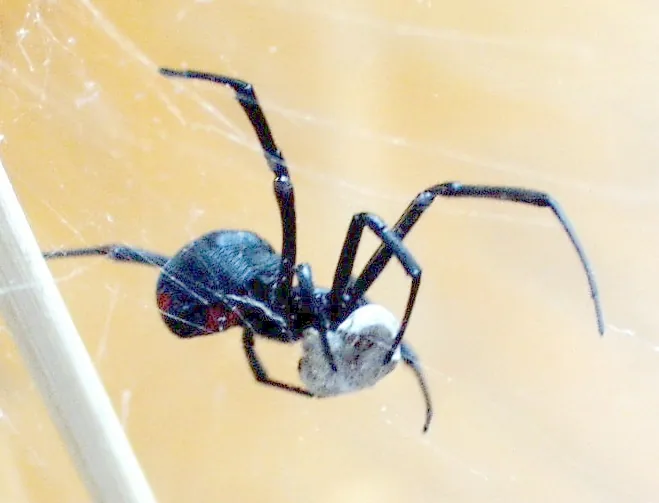
The southern black widow is a venomous spider that lives in North America. Mature females are shiny black with a red hourglass mark on their underside. Its bite can cause pain and other symptoms, but it is rarely fatal to healthy people.1
🔍 How to recognise it
- Mature females are shiny black, with a red hourglass-shaped mark on the underside of a very rounded abdomen.1
- Many females have an orange or red patch on the top of the abdomen, just above the spinnerets.1
- Mature females have a body length of 8–13 mm, not counting the legs. Males are 3–6 mm.1
- Juveniles look very different. They have a grey to black abdomen with white stripes across it, spotted with yellow and orange.1
- Males are either purple, or look more like the juveniles.1
Often confused with: It is often confused with the false widows (genus Steatoda) and with the closely related northern (L. variolus) and western (L. hesperus) black widows. The text does not give a clear way to tell them apart.1
Venom power
Venom comes out through its fangs or teeth when it bites.
What does its venom do?
The venom contains alpha-latrotoxin, a neurotoxic venom that attacks the nerves. It causes pain and other symptoms, which are collectively called latrodectism. The text does not say how quickly these symptoms appear in people.1
How dangerous is it to people?
Danger to people: SeriousA bite or sting needs a doctor. Deaths are very rare.Deaths in healthy adults are exceedingly rare. The text reports no deaths among 23,409 documented Latrodectus bites in the US from 2000 to 2008, though it does note that about 2,000 bites happen each year. Only mature females can bite people.1
💉 Good news: doctors have a medicine (antivenom) or a treatment for this.1
🚑 If it bites or stings
- Wash the bite and put an ice pack on it for the pain. Get medical help if the pain is strong, spreads or the person feels unwell.
Always call your emergency number first (112, 000, 911). This is general first aid guidance, not medical advice. First aid basics
⛑️ Stay safe
- Never touch, catch or tease a wild animal, even a small one, and even if it looks asleep or dead.
- Give it space. If you meet one, stay calm, step back slowly and let it go its own way.
- If one bites or stings you: stay calm, keep still, call your emergency number (112, 000, 911) or get to a hospital fast. Remember what it looked like, a photo helps.
It is not out to get you. It uses its venom to catch food or to protect itself, and it would much rather hide. More about staying safe
Where in the world?
How big is it?
How long is it?
How big is Southern black widow compared to YOU?
Just maths in your browser. Nothing is saved or sent anywhere.
How fast is it?

Facts
Females will occasionally eat their mates after reproduction.1
Only mature females can bite people. Their hollow, needle-like mouthparts are about 1 mm long, which is long enough to inject venom into people.1
In 1933, Allan Blair let himself be bitten by one of these spiders to study its venom in humans and to convince sceptics that it could be dangerous.1
The brown widow (Latrodectus geometricus) competes with black widows for territory. In areas where they share space, it can displace them.1
Males live only about three to four months, while females can live for up to three years.1
Until 1970, the three North American black widow species were all classed as one species, L. mactans.1
Myth buster
Myth: A black widow bite is usually fatal.
Truth: Black widow bites are rarely fatal to healthy people. The text reports no deaths from the US species among 23,409 documented bites from 2000 to 2008.1
For venom experts
- Scientific name
- Latrodectus mactans
- Group
- Spiders
- Also called
- Black widow, Shoe-button spider, Cherry spider1
- Family
- Theridiidae2
- Order
- Araneae
- Continents
- North America
- Babies
- A female can produce four to nine egg sacs in one summer, each holding about 100–400 eggs, which she guards in a silken container.1
- Lifespan
- about 3 years1
- Danger to people
- 3 / 5: Serious3
Where the facts come from
- Latrodectus mactans (Wikipedia (CC BY-SA 4.0))
- Latrodectus mactans (iNaturalist): names and classification.
- Venom Wiki: the danger level, the typical size and the speed guess are our own. See how we work them out: How we rate danger.
Every fact on this page has a number that points to its source. If we got something wrong, sorry, we are animal fans, not a science journal. Tell us at [email protected] and we will fix it.
 The spider is hungry! Venom Wiki is a dad's project for his animal-loving kids, free with no ads and no trackers. Grown-ups can drop a snack in the basket to help keep it online.Feed the spider
 Brown recluse
 Northern black widow
 Western black widow
 Bold jumping spider
 Golden silk orb-weaver
 Central American wandering spider
 Terciopelo
 Eastern coral snake
 Eastern diamondback rattlesnake
 Eyelash viper
 Timber rattlesnake
 Western diamondback rattlesnake